
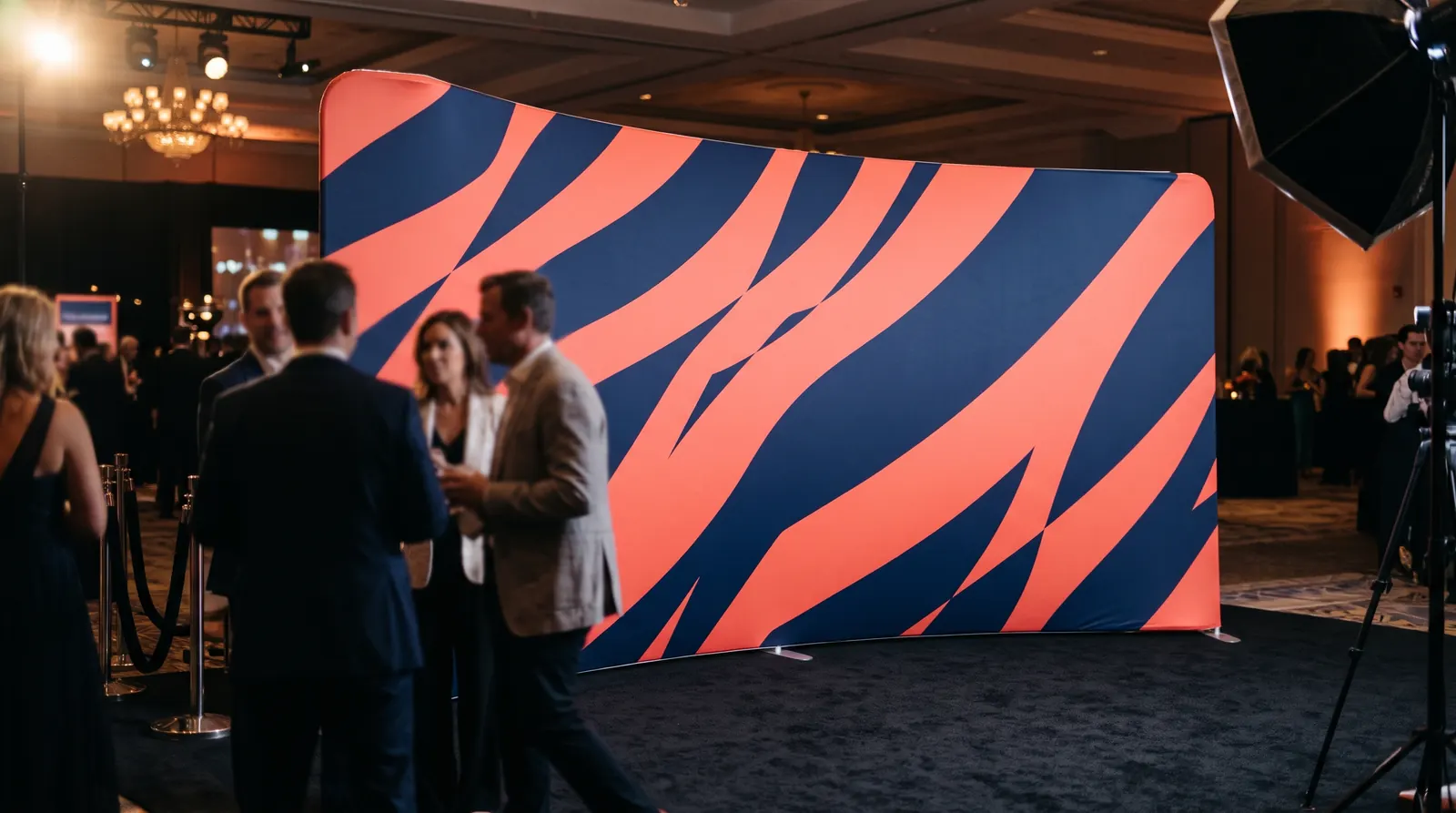
What a branded backdrop stand is for
A photo backdrop is a free-standing wall that guests stand in front of while a photographer, or the guests themselves, take pictures. The corporate version is printed with a logo, usually repeated in a regular pattern, so that every shot, however tightly cropped, shows the host or sponsor brand.
You will see them at awards dinners, conferences, product launches, company anniversaries, Christmas parties and exhibitions. The photos then end up on social media, in press coverage and newsletters, so the backdrop keeps working long after the event.
What size backdrop stand do you need
Width depends on how many people will be in each photo, and height on the framing. For full-length shots the photographer steps back, so the backdrop has to be wider than the group. The figures below are a guide.
| Use | Backdrop width | Example frame |
|---|---|---|
| Selfie corner, 1–2 people, waist up | 100–200 cm | Display wall MEGA SEG, Versum (banner version) |
| Press wall, 2–4 people, full length | 250–300 cm | Atlantis straight display wall, Versum XL (banner version) |
| Group photos, 5–10 people | 400–590 cm | Atlantis straight display wall at 400 or 590 cm |
| Evening gala with a lit background | 200–600 cm | Display wall BACKLIGHT, LUNIX |
The standard height of 230–250 cm covers standing guests, tall ones included, with room above their heads. Anything under 200 cm only works for waist-up shots. Allow 3–4 m of clear floor in front of the backdrop for the photographer and the queue.
Step and repeat design: how to place your logo
A classic step and repeat banner repeats the logo in a staggered grid, with each row shifted by half a step. That way, even when a photo is cropped to portrait, at least one complete logo stays in the frame.
Logo size and spacing
A practical rule: in a waist-up shot, which shows a strip of background about 1 m wide, two full logos should fit. That gives a logo 25–40 cm wide repeated every 40–60 cm. A bigger logo is easily hidden by people, while a smaller one disappears in phone photos.
Several sponsors
With several brands, alternate them in the same grid and give them a similar visual weight rather than identical widths. The host logo can appear more often. Do not put logos only in the lower part of the backdrop, as guests will cover them.
Colour and background
A solid background in a brand colour or a neutral tone, with logos in strong contrast, works best. Pure white tends to burn out under flash, and fine patterns or thin lines can shimmer on screens. Supply the logo as a vector file and size the artwork to the graphic dimensions listed for your chosen model.
Fabric or banner
Most photo backdrops are printed on polyester fabric. It is matt, so it does not bounce back flash or stage lights, and once tensioned on the frame it shows no creases. A fabric graphic also folds into a bag for transport.
A banner on an adjustable frame, such as the Versum (banner version), is a cheaper and quick option, including for a one-off event. Choose a matt material, as a glossy banner creates a hotspot in every flash photo. If the venue requires flame-retardant materials, ask your printer for the right certificate before you order.
Which backdrop stand works best
- Versum banner frame — the Versum (banner version) adjusts from 110x92 to 240x240 cm and weighs 5.8 kg, while the Versum XL (banner version) goes from 175x100 to 300x240 cm. Handy for events in different rooms, as you size it to the artwork.
- Atlantis fabric display — the Atlantis straight display wall in 250, 300, 400 and 590 cm widths, with a double-sided fabric sleeve. It looks finished from behind, so it can stand in the middle of a room.
- Pop up stand — the Straight POP UP display with case in 3x3 or 3x4 gives a rigid surface, but vertical joins show between panels and laminate can shine. Better for a stand than for photos.
- Backlit wall — the Display wall BACKLIGHT in widths of 100–600 cm or the LUNIX with LED. The background glows evenly, which helps at evening events and in dark rooms.
- Small fabric frame — the Display wall MEGA SEG at 100–150 x 200 cm and 2.1–3.2 kg, for a selfie corner by reception.
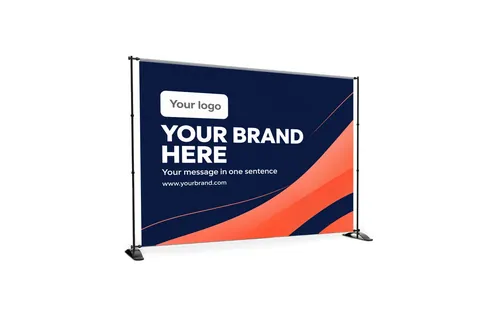
Versum (banner version)
€95.00 incl. VATIn stock — ships in 1–2 business days

Atlantis straight display wall
from €145.66 incl. VAT4 versions
In stock — ships in 1–2 business days
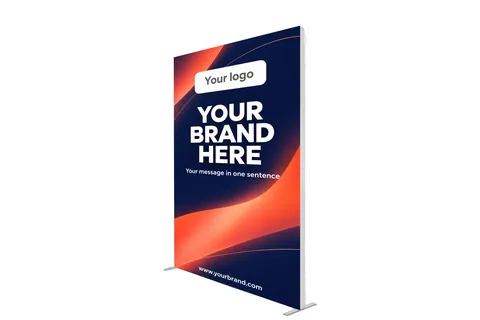
Display wall BACKLIGHT
from €492.03 incl. VAT6 versions
In stock — ships in 1–2 business days
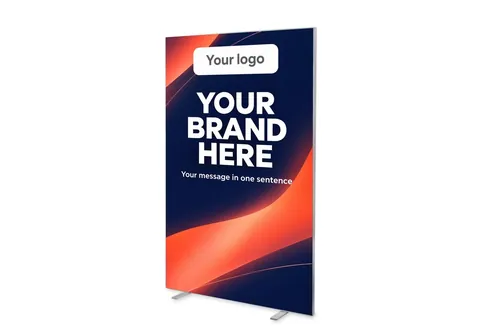
Display wall MEGA SEG
from €72.59 incl. VAT3 versions
In stock — ships in 1–2 business days
For a detailed comparison of frame types, see pop up stand vs fabric display.
Positioning and lighting
Do not place the backdrop in front of a window, as light from behind turns guests into dark silhouettes. A window behind the photographer, on the other hand, helps. Guests should stand 0.5–1 m in front of the backdrop, so the flash shadow falls lower and not right behind their heads.
In a poorly lit room, set up two lights at the sides at roughly 45 degrees. For Atlantis displays there is a Light bracket for Atlantis displays. Mark the spot where guests should stand with floor tape, and run cables behind the backdrop, taped down.
A free-standing backdrop needs no drilling, but it must be stable. Keep it away from doors and walkways, and outdoors use only frames designed for outdoor use, secured as the instructions specify.
Backdrops for different events
- Awards dinner or gala — a 300–400 cm press wall at the entrance, a dark background with a logo grid and a carpet leading guests in. Keep the photographer at the backdrop while guests arrive, as that is when most photos are taken.
- Conference — one backdrop at registration for speakers and partners, and a wider one behind the stage. The stage backdrop is in every session photo, so place the logos higher, above the speakers' heads.
- Product launch — the product, campaign line and hashtag in the artwork, with the product itself on display next to it so guests can pose with it.
- Exhibitions — the back wall of your stand doubles as a photo backdrop for visitors. On an island stand, a double-sided Atlantis display works from both sides.
- Staff and Christmas parties — a seasonal theme with a discreet logo. The same frame can be used every year with a new graphic.
Plan for the day
- Put the backdrop up the day before, or at least 2 hours before doors open, and take a test shot with flash.
- Check the graphic is evenly tensioned and that no plants, stands or lights hide the logos.
- Place a Snap frame Standard – poster frame A5–A0, B3–B1 in A2 or A1 next to it with the event hashtag and where the photos will be published.
- Ask one person to look after the backdrop area, straighten the graphic and clear cups and bags out of shot.
- After the event, fold the graphic loosely without sharp creases and label the bag, so you know what is inside next time.
Common photo backdrop mistakes
- One huge logo in the centre — guests cover it completely and the photos show fragments of letters.
- Glossy material — the flash leaves a white patch behind every head.
- Artwork the wrong size — fabric or banner that is too small or too big wrinkles or sags. Check the graphic size on the product page.
- Too narrow — in group shots the edges of the frame show chairs, doors and fire exits.
- No space in front — the photographer cannot step back and the queue blocks the walkway.
For party ideas such as an 18th birthday or a wedding, see photo wall ideas. Other ways to brand an event are covered in corporate event branding ideas.
How to order a backdrop stand
Choose your frame in display walls and lights or bags in accessories. You can ask us about printing in a quote request or have it printed by any print shop. We list the graphic size with every product.
In-stock items ship within 1–3 working days across the EU, with a VAT invoice. Event agencies and hire companies get B2B prices with a business account. For several backdrops for a series of events, send a quote request.
Frequently asked questions
What size should a photo backdrop be?
For full-length photos of 2–4 people, choose a backdrop 250–300 cm wide and about 230 cm high. A selfie corner needs 100–200 cm, and group shots of 5–10 people need 400–590 cm. Leave 3–4 m of clear space in front for the photographer and the queue. We list the graphic size for each model on its product page.
How big should the logo be on a step and repeat banner?
In a classic grid the logo is usually 25–40 cm wide and repeats every 40–60 cm, with alternate rows shifted by half a step. That way at least two full logos appear in a waist-up shot. One large logo in the middle is a mistake, as people will hide it. Supply the logo as a vector file.
Fabric or banner for a photo backdrop?
Fabric gives better photos, as it is matt and, once tensioned on the frame, has no creases or joins. It also folds into a bag. A matt banner on an adjustable frame is cheaper and fine for a single event. Avoid glossy materials, because flash leaves bright patches right behind guests' heads.
Can one person put up a backdrop stand?
Yes, for a Versum frame, a MEGA SEG frame or an Atlantis display up to 300 cm wide. They go up without tools, usually in a quarter of an hour or so. For 400–590 cm walls and backlit frames, two people are better, as someone needs to hold the frame while the other fits the graphic. See how to assemble a fabric display.