Conference equipment: six zones to plan
The simplest way to avoid gaps is to walk the delegate journey: from the hotel entrance, through registration and the main room, to the coffee break and the exit. Each stage of that journey is a separate zone with its own kit list. The table below puts all the conference equipment in one place, and the sections that follow go through it in detail.
| Zone | Core equipment | Watch out for |
|---|---|---|
| Entrance | directional roller banners, welcome wall | visibility from corridors and lifts |
| Registration | exhibition counter, table with cloth, branded backdrop | queues must not block the room entrance |
| Stage | stage backdrop, banners either side, speaker table | logo above head height, clear of the screen |
| Breakout rooms | event tables, folding chairs, tablecloths | layout that respects escape routes |
| Sponsor area | counters and banners for exhibitors, leaflet stands | equal conditions for every sponsor |
| Networking | cocktail tables with covers, photo backdrop | clear walkways around catering |
AV equipment such as the projector, screen, PA system and microphones usually comes from the venue or a production company. This checklist focuses on what shapes the look of the event and how guests are looked after: display systems, furniture and accessories.
Entrance and wayfinding
First impressions form before delegates reach the room. Conference hotels often host several events at once, so guests need to know straight away where to go.
- Welcome banner — event name, logo and an arrow to registration. The Standard roller banner in 85 or 100 cm widths fits a narrow corridor and weighs around 2 kg.
- Directional pull up banners — place them by lifts, stairs and corridor junctions. Keep the message to the event name, an arrow and the room number, because people read it on the move.
- Welcome wall — at larger events, a wide wall in the lobby turns the entrance into a gateway. The Atlantis straight display wall comes in widths from 250 to 590 cm and stands 230 cm tall.
- Floor plan and agenda — a printed room plan on a banner or stand saves your team from answering the same questions all day.
Registration and reception
Registration is where every delegate meets the organiser face to face. The desk has to be clear, tidy and wide enough that staff are not handing out badges from behind a single laptop.
- Branded registration counter — a promotional counter replaces a random table and marks the registration point at a glance. Counter Promo 2 has a kidney-shaped top and measures 91×45×93 cm, while the lighter Preston oval counter weighs about 6 kg and comes with a carry bag.
- Badge table — the E180 event table has a 180×75 cm top and stands 74 cm high. Dress it with the matching E180 tablecloth and the desk instantly looks finished.
- Backdrop behind reception — a banner or wall behind your staff means registration photos show the brand, not the hotel wall.
- Agenda and leaflet stand — the Montana leaflet stand in A4 or A3 packs into a bag, and the Concord 2-in-1 counter combines a worktop with leaflet holders.
With a large guest list, split registration into two or three desks by surname, for example A–K and L–Z, and sign each one clearly above the counter.
Stage and main room
The stage ends up in photos, recordings and social media posts. The backdrop behind the speaker works all day, so it deserves the biggest share of your attention and budget.
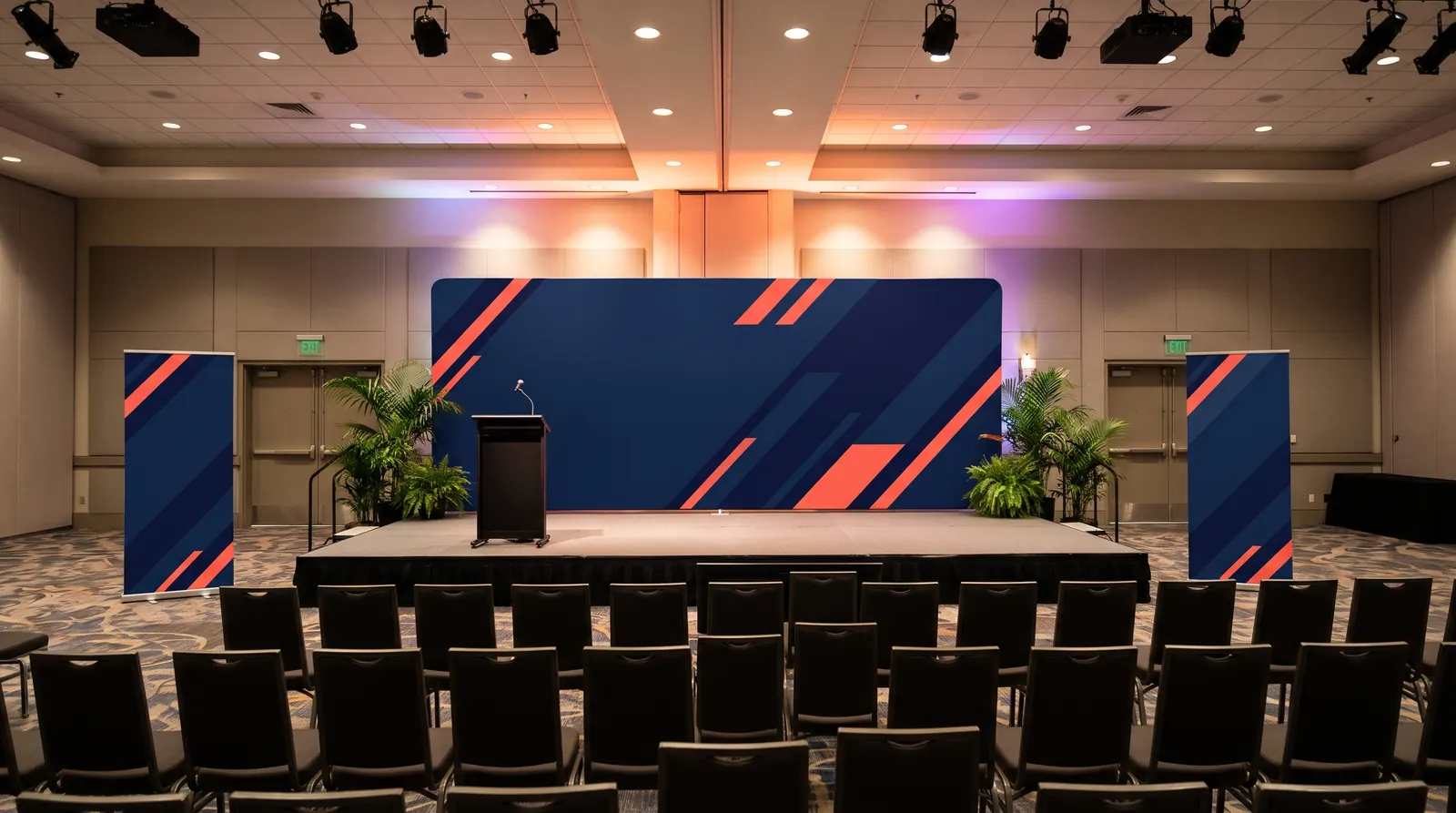
- Stage backdrop — the usual choice is a fabric wall or a pop up stand. The straight POP UP display in a 3×3 configuration measures 274×230 cm when set up and travels in a case. For wide stages, choose an Atlantis wall at 400 or 590 cm.
- Banners either side of the stage — a matching pair of roller banners frames the shot. For conference rooms the Exclusive roller banner with its rounded cassette works well and comes in silver or black.
- Backlit backdrop — in a darkened room, graphics lit from behind stay legible even when house lights are dimmed. Our guide to LED light boxes and LED display walls explains these systems.
- Speaker table — for panel discussions, set up an E180 table with a tablecloth in your brand colour and chairs for the panellists.
Place the logo on the stage backdrop in the upper part of the graphic, at head height and above. Speakers, the lectern and the table will hide the lower band, and the projection screen often covers part of the centre.
Training and breakout rooms
A training session or workshop needs comfortable places to work above all. Hotels have their own furniture, but at a warehouse, office or empty venue you bring it yourself.
- Work tables — the rectangular E180 table suits classroom layouts, while the R122 round table with a 122 cm diameter makes small group work easier.
- Folding chairs — the folding chair weighs 4.5 kg and is packed in fours, which makes it easy to count boxes for transport.
- Tablecloths — stretch-blend tablecloths matched to a specific table stay neat all day and help hide laptop cables.
- Room signage — when sessions run in parallel, place a banner with the room name and workshop title at every door.
Sponsor and partner area
If the conference has sponsors, they need clear, visible spots. Matching equipment looks professional and gives every partner the same conditions.
- Exhibitor points — each partner gets the same kit: a counter, a roller banner and a leaflet stand. Lightweight Preston counters are easy to move during breaks.
- Sponsor wall — one wall carrying every partner logo, often combined with the photo area. For adjustable dimensions, choose the Versum banner wall, which sets up anywhere from 110×92 to 240×240 cm.
- Low dividers — the MEGA SEG display wall from 100×200 to 150×200 cm weighs 2–3 kg and separates neighbouring stands neatly.
Networking, coffee breaks and the photo area
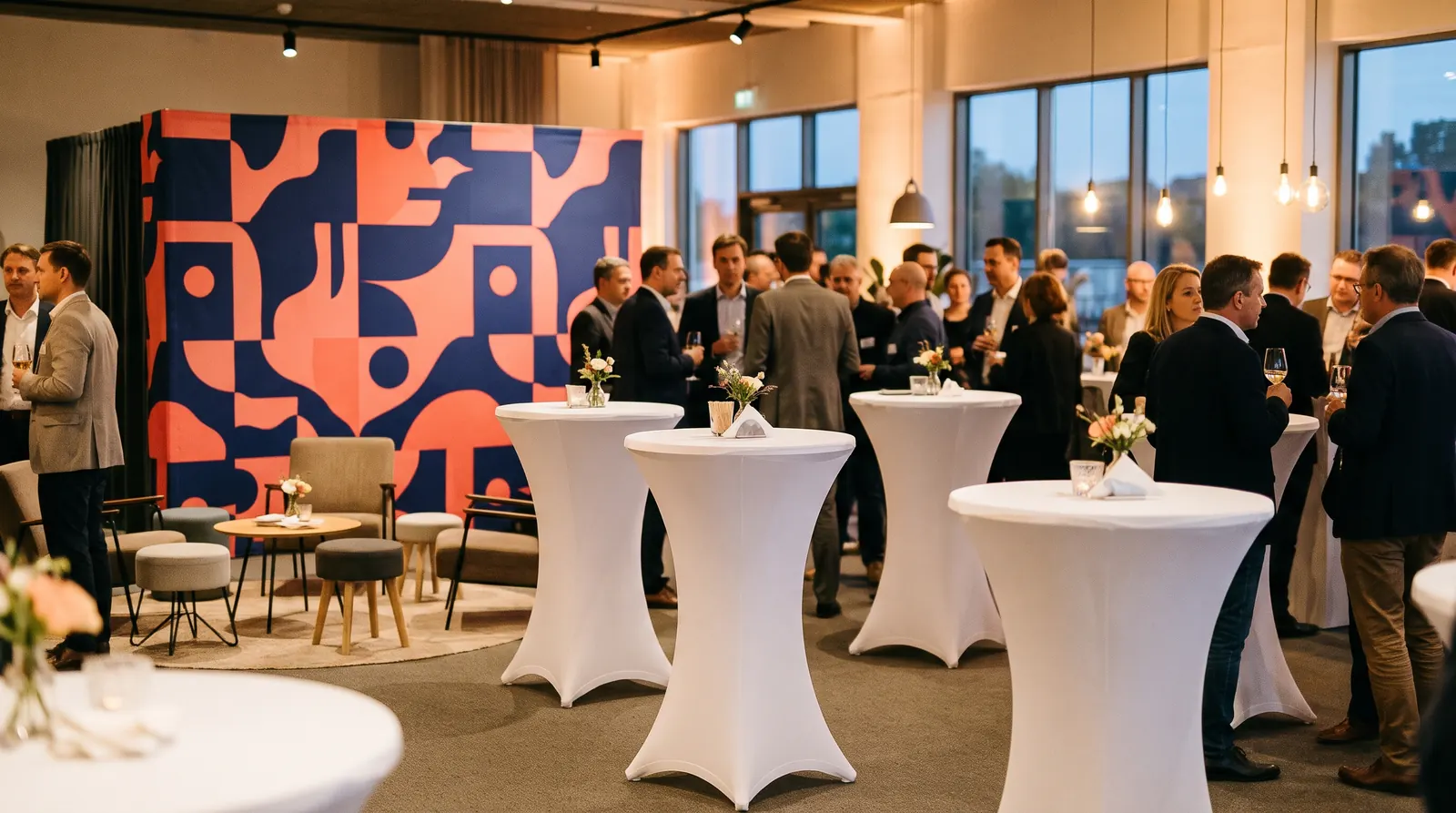
During breaks people talk standing up, so they need surfaces for cups and plates. Poseur tables ease crowding at the buffet and give the space some structure.
- Cocktail tables — the C80 high cocktail table has an 80 cm round top and stands 110 cm tall. As a starting point, allow one table for every 8–10 standing guests and adjust once the room plan is ready.
- Cocktail table covers — the C80 tablecloth in white or black turns a plain table into part of the styling.
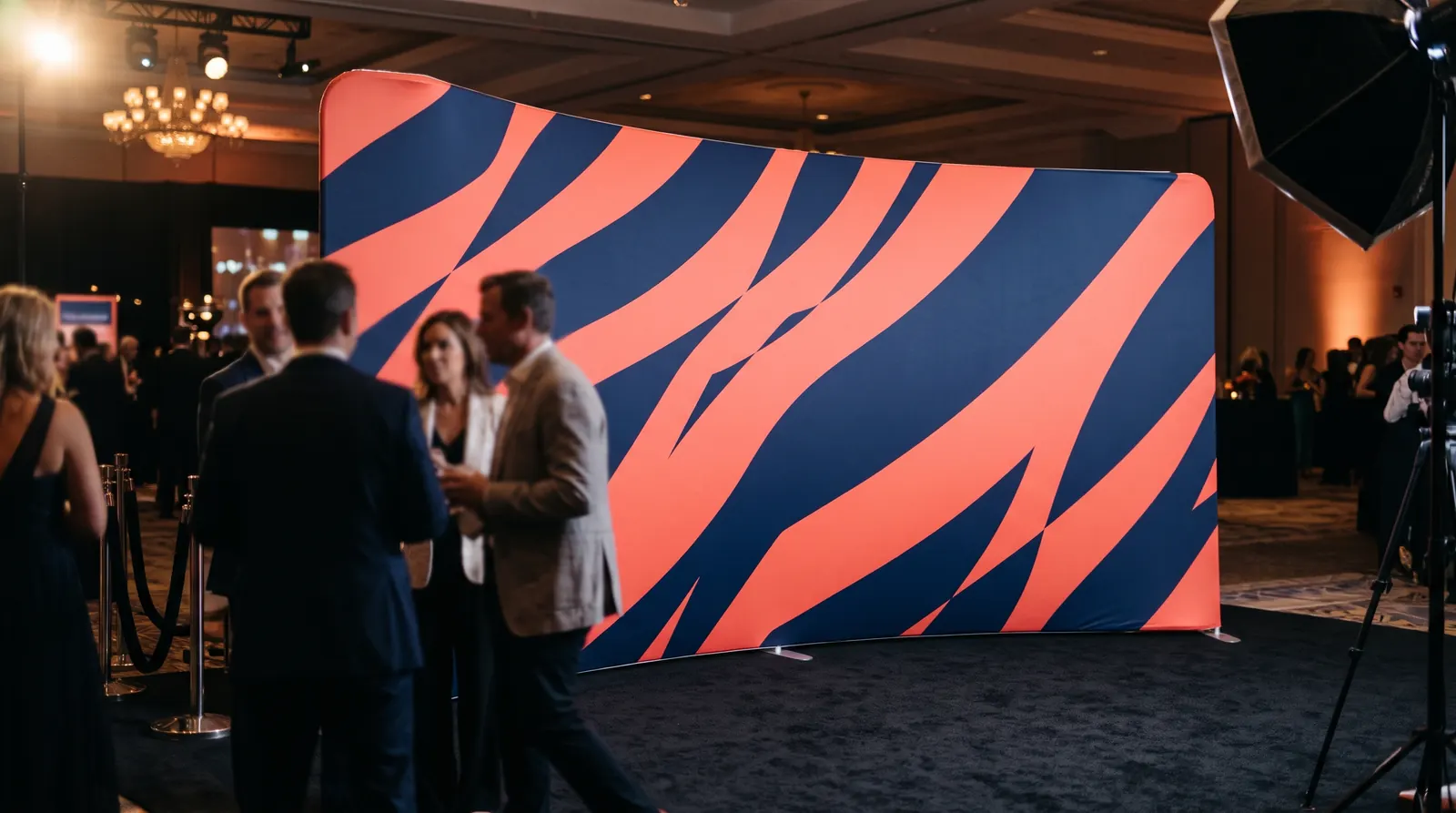
- Photo backdrop — a branded spot for photos draws delegates in and gives you content for event coverage. Our guide to the branded photo backdrop shows how to plan it.
- Signposts — more banners guide people to catering, the cloakroom and breakout rooms.
Choosing tables, chairs and covers is covered in more depth in our guide to event furniture for conferences and galas.
Logistics, graphics and an example kit
Before ordering, check the venue's set-up times, delivery access and lift size. A 3×3 POP UP display in its case weighs around 25 kg and an E180 table around 12 kg, so for a larger kit plan a trolley and two people for unloading. Roller banners and lighter counters come with carry bags, which makes the return trip to storage easier.
Keep the graphics in one style: the same colours, logo and typeface on every item. We list the graphic size on every product page. You can ask us about printing in your quote request or have the graphics printed by any print shop.
An example starter kit for a one-day conference: two roller banners, a stage backdrop, a registration counter and two tables with cloths. That kit comes to from €453.02 incl. VAT before graphics. For a full scenario at a bigger event, see our example kit for a hotel conference.
Standard roller banner – pull up stand 85–150 cm
from €26.98 incl. VAT6 versions
In stock — ships in 1–2 business days
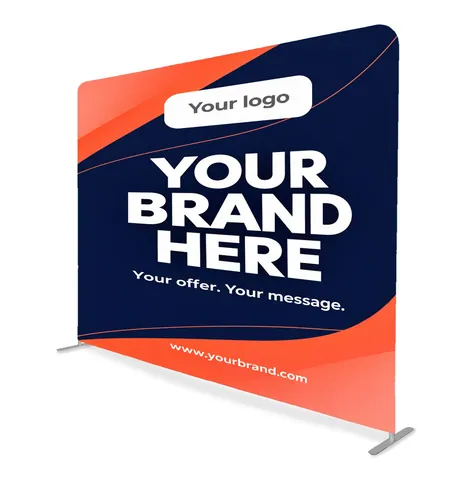
Atlantis straight display wall
from €145.66 incl. VAT4 versions
In stock — ships in 1–2 business days
- Deal of the week
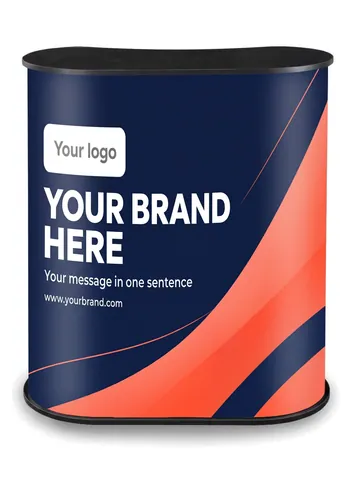
Counter Promo 2 with heavy-duty top
from €117.63€153.94incl. VATLowest price in the 30 days before the discount: €153.942 versions
In stock — ships in 1–2 business days
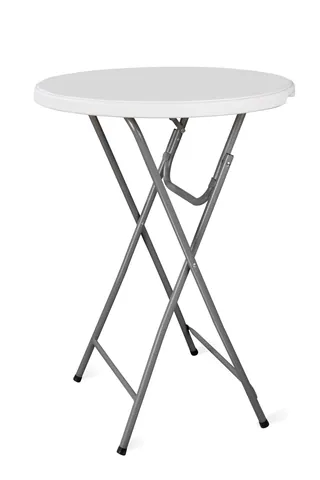
C80 high round cocktail table
€48.85 incl. VATIn stock — ships in 1–2 business days
What organisers most often forget
Most problems on the day are not about the big items but about small things nobody thought of. Add them to the list alongside the rest of the equipment.
- Extension leads and power strips — at registration, the speaker table and any backlit walls. Check with the venue in advance where the sockets are.
- Spare badges and pens — for late registrations and anyone who has lost their badge.
- Tape, scissors and cable ties — for quick fixes to cables and signs.
- Carry bags and transport cases — kit packed in a hurry without its bags is easily scratched, and small parts go missing.
- A trial set-up — put up the wall and banners a few days beforehand to check the graphics and that nothing is missing.
- A named lead for each zone — one person looks after registration, another the stage, a third the sponsor area.
How to order conference equipment
You can order individual items directly in our shop: roller banners, display walls, exhibition counters and tables, chairs and tablecloths. In-stock products ship within 1–3 working days, with fast delivery across the EU, and every order comes with a VAT invoice.
If you run corporate events regularly or are equipping several events at once, open a business account with B2B prices. For larger quantities or a kit with printed graphics, send us your list through the quote request form and we will prepare a quote.
Frequently asked questions
What equipment do you need for a conference?
Beyond the room and AV kit, you need equipment for six zones. Directional roller banners work at the entrance, a counter and a dressed table at registration, and a backdrop with banners either side on stage. Breakout rooms need tables and chairs, sponsors need counters and leaflet stands, and the networking area needs cocktail tables and a photo backdrop.
How many roller banners does a conference need?
A small single-room conference usually manages with four: one at the entrance, one at registration and two either side of the stage. Add one for each breakout room, directional banners at lifts and corridor junctions, and banners for sponsors if you provide them. The count is easiest when you walk the delegate route with the venue floor plan in hand.
Should you use a display wall or a roller banner behind the stage?
A display wall works better behind a stage. A roller banner is usually 85–150 cm wide, so it cannot fill the space behind a speaker, while a fabric wall runs from 250 to 590 cm wide and 230 cm high. Roller banners complement the wall well: a matching pair either side of the stage frames the shot in photos and recordings.
Which tables work best for coffee breaks?
High cocktail tables, also called poseur tables, work best because guests can talk while standing. The C80 table has an 80 cm round top and stands 110 cm high, and a white or black tablecloth gives it a smart finish. For the buffet and drinks station, choose longer tables such as the rectangular E180 with its matching cloth.
Is it better to buy or hire conference equipment?
Buying makes sense if you run corporate events regularly or manage an agency where the same kit goes out to event after event. Roller banners, walls and counters let you change the graphics, so one set can serve many different conferences. For a one-off event, compare hire quotes with the purchase price. Companies and agencies can buy from us at B2B prices through a business account.