
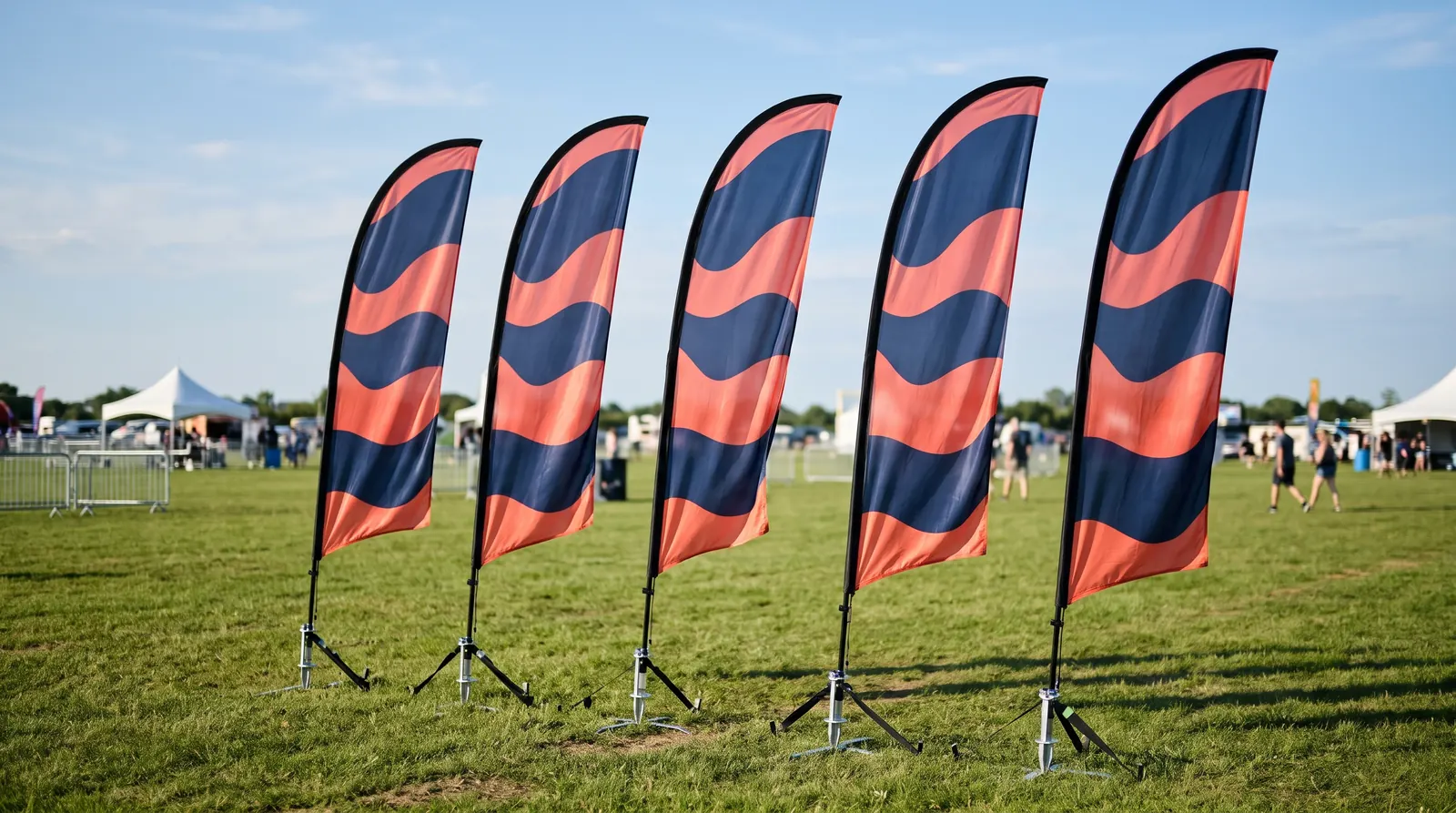
Which flag base do you need — the short answer
A flag base keeps the pole upright and takes the force of the wind on the fabric. Choose it first by the surface, then by pole height and by how often the flag moves to a new spot. A simple rule of thumb:
- Grass, soil, showgrounds — a ground spike or a ground screw anchor.
- Paving, concrete, pavements — a water base, a metal base plate or a heavy rubber base.
- Indoor floors in halls, showrooms and shopping centres — a base plate with rubber feet or a weighted cross base.
- Car parks, forecourts, car showrooms — a car wheel base.
- Stands with a gazebo — a gazebo-mounted flag base.
You will find every model in our flag bases category. When ordering, check how the base connects to the pole, because it has to fit the model you use.
Flag bases compared
| Base | Surface | Strengths | Limitations |
|---|---|---|---|
| Cross base | Hard and level, indoors | Light and quick to set up | Needs ballast outdoors |
| Water base | Paving, concrete, pavements | Light to carry empty, stable when full | Needs water, can freeze in winter |
| Ground spike | Grass, soil | Light, nothing heavy to carry | Not for paving or concrete, weaker in loose ground |
| Ground screw | Grass, soil | Screws in and holds well in firm soil | Takes effort to screw in, not for hard surfaces |
| Metal base plate | Indoor floors, paving, halls | Flat, no water needed | Heavy to transport |
| Rubber base with rotator | Paving, concrete, indoor floors | High weight, rotator included | The heaviest to move |
| Car wheel base | Car parks, forecourts, showrooms | The car's weight holds the flag | Needs a parked vehicle |
| Gazebo base | Next to a gazebo frame | Flag by the gazebo with no separate ballast | Only works with a gazebo |
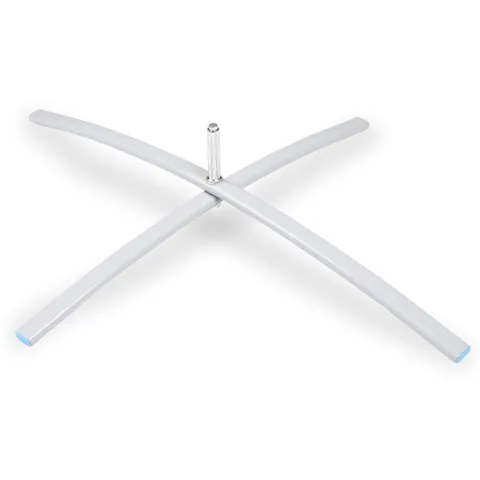
Tubular cross flag base — grey
€18.31 incl. VATIn stock — ships in 1–2 business days
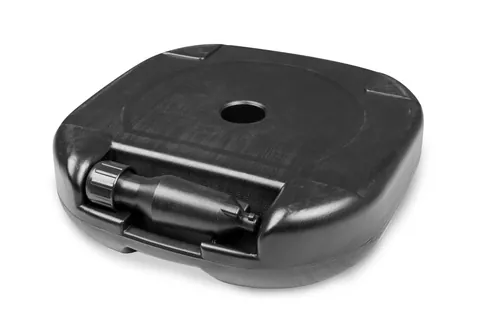
Water-fillable flag base
€22.60 incl. VATIn stock — ships in 1–2 business days
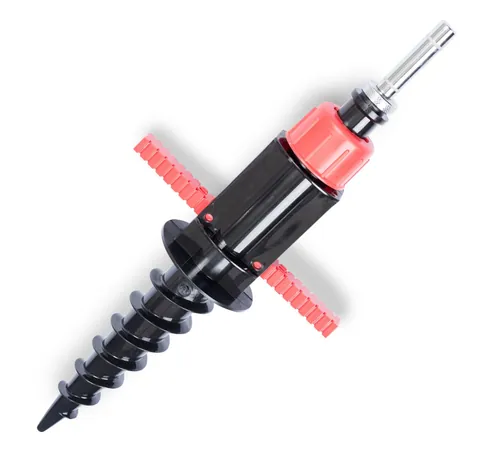
Dryl ground screw anchor
€21.68 incl. VATIn stock — ships in 1–2 business days
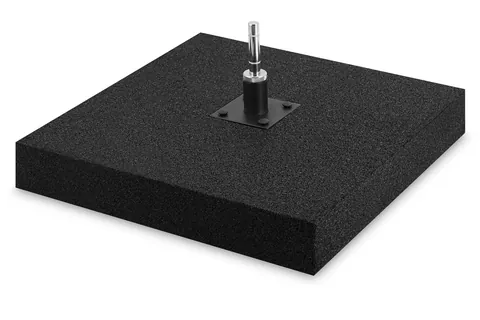
19 kg rubber flag base with rotator
€84.51 incl. VATIn stock — ships in 1–2 business days
Cross base
A cross base is the simplest option: four arms resting on the floor and a socket for the pole. The tubular cross base is made of iron, measures 82×68×15 cm and weighs 1.4 kg. It comes in grey and black, so you can match it to an interior or a stand. The flat cross base weighs 2.25 kg.
On its own a cross base is light, so without ballast it is mainly for indoor and sheltered spots. Outdoors, lay a filled water weight bag on top. The bag weighs 0.15 kg empty and packs flat, so it is easy to take to every event.
Water base for a feather flag
A water base is a tank you fill on site. Empty, the water-fillable flag base weighs 1.2 kg, so you can carry several in one car, and once filled it becomes a heavy, stable base. It is a good choice outside shops, on pavements and on paved event sites.
There are three versions: the standard water base, the water base with spindle and the water base with rotator, which lets the flag turn with the wind.
- Fill it to the top — a half-filled base is lighter and easier to shift.
- Tighten the cap — leaking water reduces the weight and makes a mess of the surface.
- Take care in winter — freezing water can damage the tank. Check the instructions and empty the base at the end of the season.
Ground spike and ground screw
On grass and soil, a base that goes into the ground is the most convenient. There is no ballast to carry, and the flag stands exactly where you put it.
- Ground spike — a classic spike weighing 0.95 kg. Drive it in vertically to its full length.
- Ground spike Twin — the Twin version, slightly heavier at 1.3 kg.
- Ground screw anchor — twists into the ground like an auger and weighs 0.7 kg. It grips firm soil better than a straight spike.
Before driving anything in, check there are no cables, pipes or irrigation lines below. In parks, stadiums and sports grounds, ask the site manager whether you may put anything into the turf. In dry, loose sand and waterlogged soil a spike holds less well, so choose a heavier base there.
Metal base plates and rubber bases
On paving, concrete and indoor floors, bases that rely on their own weight work well. They need no water or drilling, and they sit flat on the surface.
| Base | Weight | Size |
|---|---|---|
| 4 kg base plate | 4 kg | 30×33 cm |
| 6 kg base plate | 6 kg | 35×35 cm |
| 8 kg base plate | 8 kg | 39×39 cm |
| 12 kg base plate | 12 kg | 48×48 cm |
| 10 kg rubber base with rotator | 10 kg | 50×50×5 cm |
| 15 kg rubber base with rotator | 15 kg | 50×50×7 cm |
| 19 kg rubber base with rotator | 19 kg | 50×50×8 cm |
For metal plates, add a set of 4 rubber feet to protect indoor floors from scratches. Rubber bases come with a rotator, and the 19 kg version is the heaviest base in our range. Choose them for tall flags that stay in one place, for example outside a showroom.
Car wheel base and gazebo base
Car wheel base
A car wheel base is a plate you drive one wheel onto. The car's weight holds the flag, so the base itself weighs just 1.2 kg. It suits car showrooms, forecourts, food trucks and promotional teams that move from site to site. Always take the flag down before you drive off.
Gazebo-mounted flag base
The gazebo-mounted flag base lets you set up a flag by the frame of a pop up gazebo, without a separate water base or plate. It is useful at fairs, outdoor markets and sports events, where every metre around the gazebo counts. Check that the flag does not hit the roof or walls as it turns.
How to match the base to flag height and location
The taller the pole and the larger the flag, the more force the wind passes to the base. For tall flags on open ground, by roads and on the coast, choose the heaviest bases or a ground fixing. Keep light plates and unweighted cross bases for indoor and sheltered spots. If the pole manufacturer recommends a particular base, follow their instructions.
Do you need a rotator?
A rotator lets the flag turn around the pole with the wind. The fabric wraps around the pole less and the artwork follows the wind instead of fighting it. Rubber bases and the water base with rotator have one built in, and for other bases you can add a separate flagpole rotator, checking that it fits your base and pole.
Common mistakes when choosing a base
- Choosing on price alone — the lightest plate under the tallest flag is asking for trouble at the first gust.
- A spike on an unknown site — at the event you find the ground is paved or the turf must not be pierced. Ask the organiser in advance and keep a weighted base as a backup.
- An empty water base "just for now" — a half-filled water base weighs very little and tips over easily.
- Not checking the pole connection — not every base fits every pole. Compare the fitting before you order.
- One base for everything — businesses that put flags up in different places usually keep two types: one for the ground and one for hard surfaces.
For more on windy conditions, read our guide to feather flags in wind, and for set-up see how to assemble a feather flag.
How to order a flag base
Choose a base in our flag bases category and a pole under flagpoles. If you are still deciding on the flag shape, start with our guide to feather flag types. In-stock products ship within 1–3 working days, with fast delivery across the EU.
Putting together flags for several sites or a mix of bases for one project? Send a quote request and we will prepare a quote with B2B prices for businesses and agencies.
Frequently asked questions
What is the best flag base for grass?
On grass and soil, a base that goes into the ground works best. You drive a ground spike in vertically to its full length, while a ground screw twists in like an auger and grips firm soil better. Both are light and spare you carrying ballast. Before driving anything in, check there are no cables or pipes underneath, and in parks or sports grounds ask the site manager first.
What flag base works on paving and concrete?
You cannot drive a spike into a hard surface, so the weight of the base has to hold the flag. Choose a water base filled to the top, a metal base plate or a rubber base with rotator weighing 10 to 19 kg. A cross base also works, but outdoors it needs extra ballast such as a water weight bag. For taller flags on open ground, go for the heaviest bases.
Is a cross base enough outdoors?
A cross base on its own is light, so outdoors it is usually not enough. Lay ballast on top, such as a filled water weight bag, and place it on level ground so all four arms touch the surface. Without ballast, a cross base is best kept for halls, showrooms and sheltered spots. In strong wind, take the flag down whatever base you use.
What is a car wheel flag base?
A car wheel base is a flag base that you drive one wheel of a car onto. The weight of the vehicle presses the plate down and holds the pole, so the base itself is light and easy to transport. Car showrooms, forecourts, food trucks and touring promotional teams use it most. Before driving off, always take the flag down and lift the pole out of the base.
Why use a rotator in a flag base?
A rotator lets the flag turn around the pole with the wind. The fabric wraps around the pole less and the artwork follows the wind instead of fighting the gusts. Rubber bases and the water base with rotator have one built in. For other bases you can add a separate rotator, as long as it is compatible with your pole and base.