Can a feather flag cope with wind?
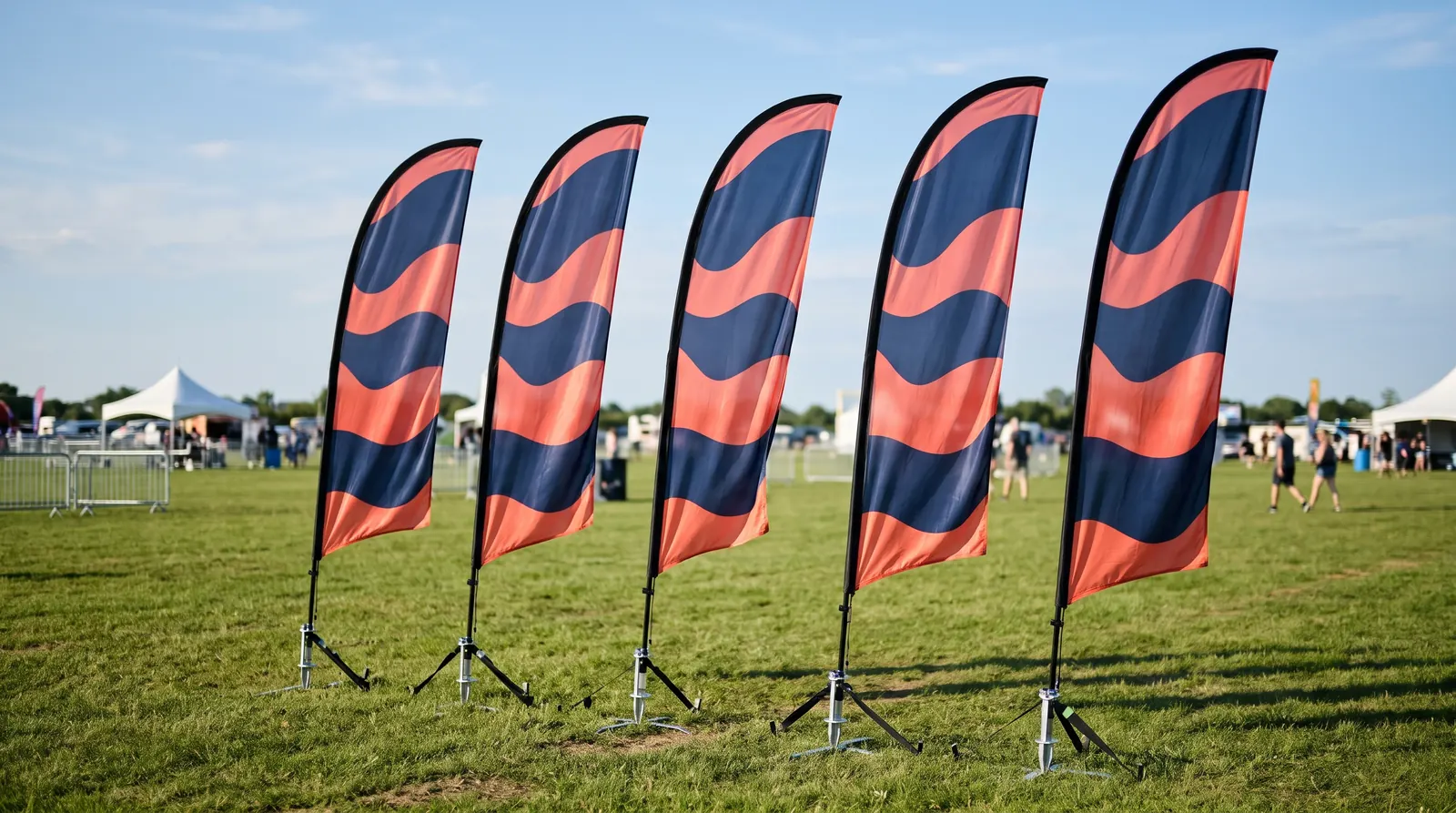
Feather flags are designed for outdoor use. The flexible pole bends with the gusts and the tensioned fabric moves with it, instead of flapping like a traditional flag. A light to moderate breeze is normal working weather, and it is when a flag looks its best.
Problems start with strong gusts. The wind pushes on the whole surface of the fabric, and that force travels down the pole to the base. If the base is too light, the set falls over. If the pole is overloaded, the tip or a section can break.
That is why there is no single wind speed at which every flag is safe. What matters is the whole set and where you place it. Follow the pole and base manufacturer's instructions, and if in doubt, take the flag down.
What keeps a feather flag stable in wind
- Height and area — the taller and larger the flag, the more force it takes. A 5.5 m pole loads the base far more than a 3 m pole.
- Shape — a large, flat rectangular flag catches more wind than a slim feather or teardrop of similar height.
- Pole — the model and length must match the flag. Fabric made for another pole tensions unevenly and overloads the structure.
- Base — its weight or ground fixing, and how well it suits the surface.
- Rotator — lets the flag follow the wind, so the fabric wraps less and tugs at the pole less.
- Location — open ground, the coast, rooftops, building corners and gaps between buildings, where gusts are stronger and keep changing direction.
The same principles apply to other outdoor displays. We cover gazebos separately in our guide to securing a pop up gazebo in wind.
How to secure a feather flag in wind — 7 rules
- Match the base to the surface and height — on grass, a ground spike driven in to its full length or a ground screw turned all the way in; on hard ground, a full water base, a base plate or a rubber base. Our guide on how to choose a flag base compares them all.
- Weigh the base down fully — fill a water base to the top and put ballast such as a water weight bag on a cross base. An empty or half-filled base is the most common reason flags blow over.
- Use a rotator — a flag that turns with the wind wraps around the pole less and loads the set more evenly.
- Choose a shorter pole for exposed sites — on an open forecourt or by the sea, a lower flag on a heavier base usually works better than the tallest one on a light base.
- Stick to one system — the flag and pole must match, and the cord should be tensioned as the instructions describe.
- Leave a clear zone around the flag — a fallen flag reaches as far as its own height. Do not place it right next to windows, parked cars or where people stand.
- Check the forecast — before an event and every morning. If strong wind or a storm is forecast, keep the flag in or take it down in good time.
Feather flags in wind on different sites
A set-up that works perfectly in a sheltered side street can fail on an open forecourt. Before you put a flag out for the first time, assess the site:
- Outside a shop in town — buildings shelter you from the wind, but in passages and at corners the gusts speed up and change direction. Place the flag closer to the wall, clear of the walkway, on a full water base or a heavy plate.
- By a road or on a forecourt — on top of natural wind there are gusts from passing lorries and buses. Keep well back from the kerb and choose a heavier base or a car wheel base.
- By the sea or a lake — the wind blows more often and more steadily, and loose sand holds spikes poorly. Shorter poles and heavy bases on a firm patch of ground work better.
- Fairs and fields — open ground with no shelter. A ground screw anchor holds more securely than a straight spike, especially in firm soil.
- Terraces, rooftops and raised areas — the wind is stronger higher up than at ground level. Agree any flag in such a spot with the building manager first.
Bases for windy locations
On hard surfaces, bases that hold the flag by their own weight give the most stability. The heaviest in our range are the 19 kg rubber base with rotator and the 15 kg rubber base. Among metal plates, the heaviest is the 12 kg base plate, measuring 48×48 cm.
If you need a base that is light to transport, choose the water base with rotator, which you fill on site. On grass and soil, go for a ground screw anchor. Keep the lighter tubular cross base for indoor use or add extra ballast to it.
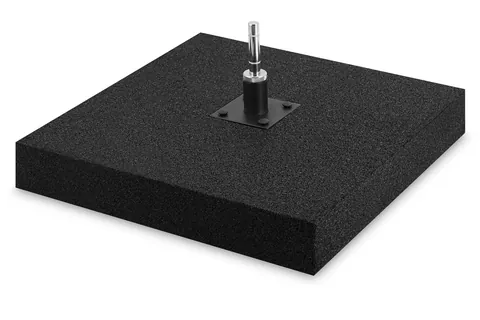
19 kg rubber flag base with rotator
€84.51 incl. VATIn stock — ships in 1–2 business days
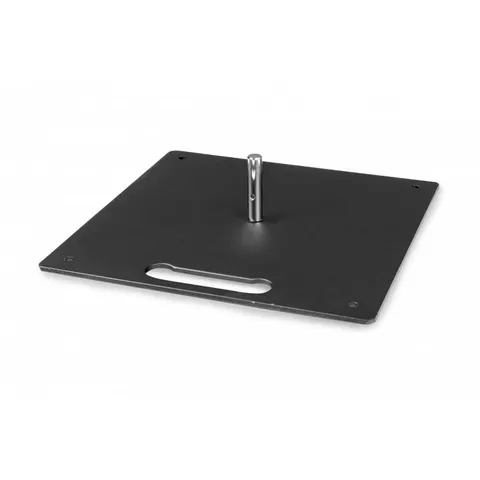
12 kg flag base plate
€85.13 incl. VATIn stock — ships in 1–2 business days
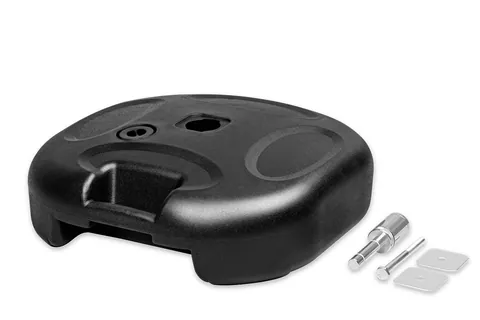
Water-fillable base with rotator
€26.88 incl. VATIn stock — ships in 1–2 business days
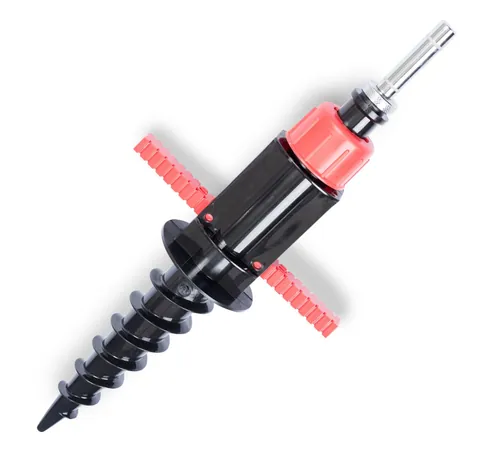
Dryl ground screw anchor
€21.68 incl. VATIn stock — ships in 1–2 business days
How to read the wind rating on a product page
For some poles, such as the Flagpole PRO and the Flagpole Standard, we list the wind-resistance rating declared for that model. Treat it as information about the pole itself, useful for comparing models with each other.
The rating does not mean the whole set will stay up in that wind. That also depends on the base, the size and shape of the flag, the surface and the surroundings. Remember too that gusts can be much stronger than the average wind speed in a forecast. When conditions look doubtful, take the flag down rather than testing the limits of your kit.
When to take a feather flag down
Take the flag down, or leave it packed, when:
- Strong wind or a storm is forecast — even if the morning is calm. A weather warning is reason enough.
- The base slides or lifts — a sign that its weight or fixing is not enough for the conditions.
- The pole bends much more than usual — or the flag jerks hard and wraps around the pole despite a rotator.
- Night falls and nobody is watching it — the weather can change within hours, and a fallen flag can hurt someone.
- There is wet snow or freezing rain — iced fabric is heavier and puts more load on the pole.
Once it is down, dry the flag before packing it away. The take-down order is in our guide on how to assemble a feather flag.
Checks after a windy day
After a windy day, spend a few minutes checking your kit. Small damage spotted early is easier to fix than a broken pole in the middle of an event.
- Tip and sections — check that the flexible tip is not cracked or splitting and that no section is bent.
- Flag — look over the sleeve, the seams and the area around the cord. Worn spots grow quickly.
- Cord and hook — make sure the cord is not frayed and the hook holds firmly.
- Base — check that the water base does not leak and the rotator turns freely.
The parts under most strain are the pole tip, the section joints, the flag sleeve and the point where the pole enters the base. Check those first.
Spares for the season
If your flags are out every day, for example outside a showroom or on a forecourt, keep a spare flag and pole of the same model to hand. A swap takes a few minutes and your advertising does not disappear while you wait for repairs. For events away from base, take an extra water weight bag or a base for a different surface, as conditions on site often differ from what you were told.
Do not use a damaged pole until the broken part has been replaced. For more care tips, see our article on cleaning and storing display systems.
How to order a set for a windy site
You will find poles in our flagpoles category and heavier bases and rotators under flag bases. In-stock products ship within 1–3 working days, with fast delivery across the EU and a VAT invoice with every order.
Putting flags up somewhere particularly exposed, such as by a main road, on the coast or on a large open site? Describe the location in a quote request and we will prepare a quote for the set with B2B prices.
Frequently asked questions
At what wind speed should I take a feather flag down?
There is no single figure that suits every flag, because safety depends on the pole, base, flag size and location. Take the flag down when strong wind or a storm is forecast, when the base starts to slide or when the pole bends much more than usual. Follow the pole and base manufacturer's instructions. If in doubt, it is better to take the flag down an hour too early than too late.
Why does my feather flag keep blowing over?
Usually the base is too light or not set up properly: a half-filled water base, a cross base without ballast or a spike driven only partly into loose ground. Other causes are a pole that is too tall for the site, a flag from another system and no rotator. Look at the surroundings too, as gusts are stronger at building corners. A heavier base and a shorter flag usually solve the problem.
How do I weigh down a feather flag?
It depends on the base. Fill a water base to the top and close it tightly. On a cross base, add a water weight bag or other ballast recommended by the manufacturer. On grass, drive a ground spike in to its full length or screw a ground anchor all the way in. On paving and concrete, the simplest choice is a heavy metal plate or rubber base that needs no water. Never tie improvised weights to a flag, as they can fall.
Does a rotator protect a flag from wind?
A rotator helps, but it does not replace a heavy base. It lets the flag turn with the wind, so it wraps around the pole less and loads the set more evenly. It does not, however, reduce the force of the wind on the fabric. In strong wind, a flag on a rotator still has to come down. Rubber bases and the water base with rotator have one built in.
Can a feather flag stay outside overnight?
It is better not to leave it out if nobody is watching it. The weather can change overnight, and a fallen flag can damage a car or a window or injure a passer-by. Taking the flag in at night also protects the fabric from damp and makes it last longer. If a flag has to stay out permanently, choose the heaviest base, check it regularly and take it down whenever a weather warning is issued.