
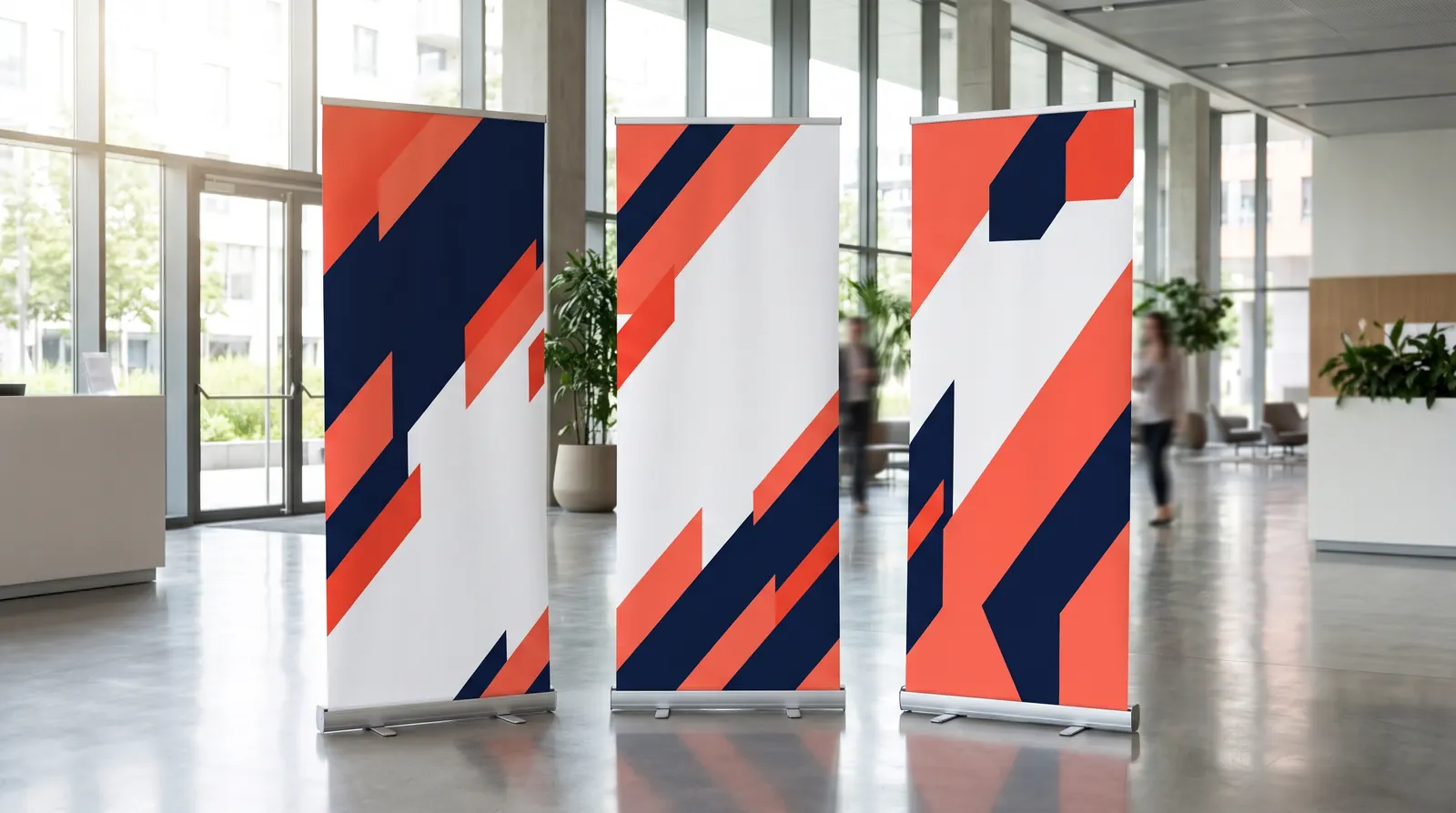
What is a roller banner?
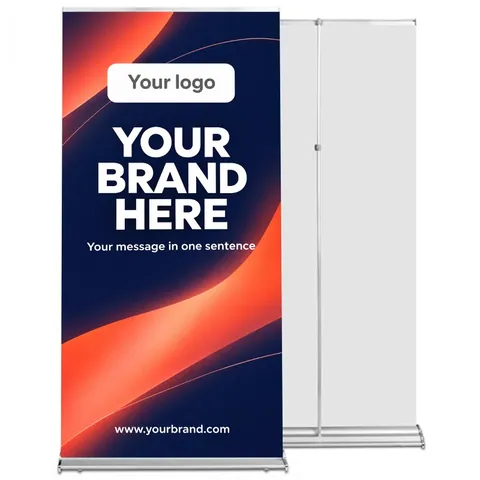
A roller banner (you will also see pull up banner, roll up banner or banner stand) is a portable, vertical poster on its own stand. The graphic is wound onto a spring-loaded roller inside an aluminium base, known as the cassette. You pull it up, hook it onto a pole and get a flat, person-height display that can be read from several metres away.
The big advantage is portability. The whole kit fits into a carry bag only slightly longer than the banner is wide, and one person can set it up without tools. That is why roller banners are standard kit for marketing teams, event agencies and any business that regularly exhibits at trade shows, conferences or training days.
At Displuno you will find roller banners from 80 to 200 cm wide: single-sided, double-sided, with a telescopic pole and with a graphic swap system.
Parts of a pull up banner
Models differ in base shape, weight and finish, but they are all built the same way. Every roller banner has these parts:
- Base (cassette) — an aluminium housing with the roller mechanism. It protects the graphic in transit and keeps the stand steady. A heavier, wider base usually stands more firmly.
- Graphic — a print on flexible material, most often blockout film. The bottom of the print stays inside the base, so the graphic is longer than the visible area.
- Top rail — stiffens the top edge of the graphic and hooks onto the pole. On our roller banners the graphic is held by an Express Clip snap rail.
- Pole — either a sectional pole that clicks together or a telescopic pole with height adjustment. It slots into a socket in the base.
- Feet — on many models, swivel feet under the base widen the footprint.
- Carry bag — included with every roller banner in our range; check the bag type for your chosen variant.
How a roller banner works
The mechanism works like a roller blind. As you pull the graphic out of the base, the spring in the roller tensions and keeps pulling the print downwards. You hook the top rail onto the end of the pole and the spring tension holds the graphic flat and wrinkle-free.
When you unhook the rail, the spring winds the print back into the base, so you need to guide it down by hand all the way rather than let go. Setting up usually takes a minute or two, and packing away about the same. We cover it step by step in how to set up and take down a roller banner.
Roller banner sizes
A classic roller banner is 200 cm tall. Models with a telescopic pole come in a 220 cm format and let you adjust the height to the room or the stand ceiling. Width is chosen from a handful of standard formats:
| Width | Best for | Example models |
|---|---|---|
| 80–85 cm | narrow spaces, reception desks, roll-outs across many branches | Compact, Standard, Classic |
| 100 cm | trade shows and conferences, more room for copy, still easy to carry | Standard, Classic, Premium, Twin |
| 120 cm | exhibition stands, stages, backdrops for speakers | Standard, Premium, Pro, Wave |
| 150 cm | stand backdrops, longer messages | Classic, Pro, Exclusive, Wave |
| 200 cm | a wide backdrop from a single unit | Pro, Exclusive |
The graphic size, including the part hidden in the base, is listed on every product page. For a full table of formats and artwork tips, read roller banner sizes.
Types of roller banner
Single-sided
The standard type: one graphic on the front, base and pole behind it. It works against a wall, behind a speaker's table or at the side of a stand. Examples include the Standard roller banner, the Classic roller banner and the Premium roller banner.
Double-sided
The Twin roller banner carries two graphics, front and back. Use it in the middle of a hall, in a walkway or a lobby where people approach from both directions.
Telescopic pole and graphic swap
The Wave roller banner and the Clip roller banner come in a 220 cm format with a telescopic pole and a graphic swap system. They make sense if you change your message every season or hire stands out to clients.
Premium and wide
The Exclusive roller banner has a distinctive rounded base in silver or black and comes up to 200 cm wide. It suits receptions, hotels and conference rooms where the look of the stand matters.
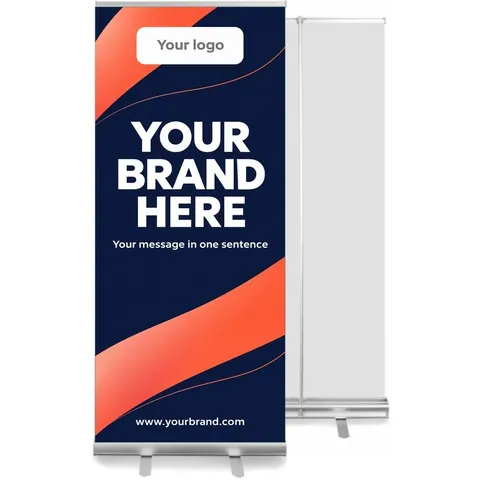
Standard roller banner – pull up stand 85–150 cm
from €26.98 incl. VAT6 versions
In stock — ships in 1–2 business days
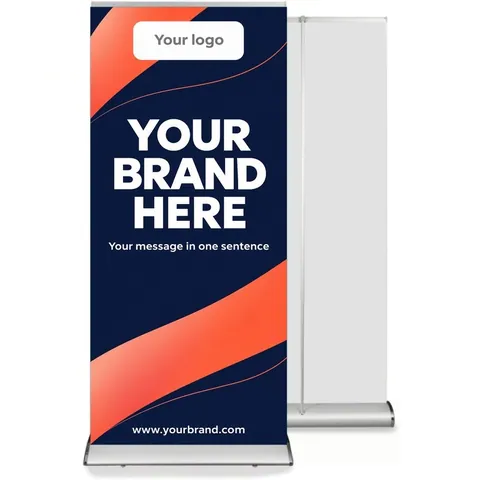
Exclusive roller banner – pull up stand 85–200 cm
from €71.40 incl. VAT10 versions
In stock — ships in 1–2 business days
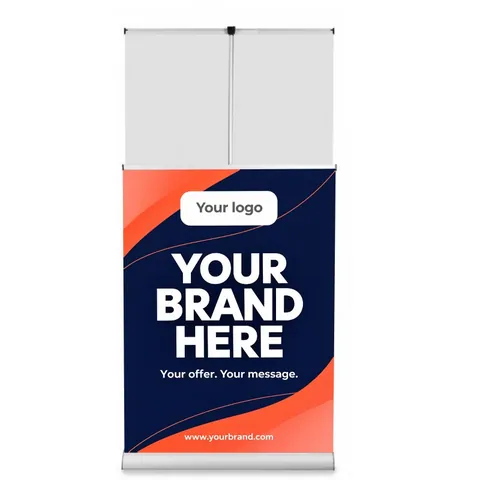
Twin roller banner – pull up stand 85–100 cm
from €72.99 incl. VAT2 versions
In stock — ships in 1–2 business days
Wave roller banner – telescopic pole, graphic swap
from €76.70 incl. VAT4 versions
In stock — ships in 1–2 business days
We compare every model with weights and typical uses in which roller banner to choose.
Where pull up banners work best
- Trade shows — stand identification, alongside a display wall, product launch messages.
- Conferences and training — speaker backdrop, sponsor logos, directional signs to rooms.
- Receptions, hotels, clinics — permanent information about services and opening hours.
- Shops and shopping centres — promotions, new collections, sampling points.
- Corporate events — open days, recruitment fairs, client meetings.
A roller banner is an indoor display. The large graphic acts like a sail, so outside even a light breeze can blow it over. In front of a shop, A-boards and pavement signs are a better choice, and outdoors feather flags do the job. If you need a backdrop wider than 2 m, look at display walls.
Artwork for a roller banner
We sell the stands; the graphics in our photos are examples. You can ask us about printing in a quote request or have it printed by any print shop. The graphic size is listed on every product page.
Most graphics are printed on blockout film, which does not let light through, so a window or spotlight behind the stand will not show through the print. You will find suitable media under print materials. When designing, keep three rules in mind:
- Logo and headline at the top — the upper half sits at eye level and stays visible above people's heads.
- Nothing important at the bottom — the lowest 30–40 cm is hidden by tables, chairs and visitors.
- A file that matches the size — CMYK, bleed and resolution as your printer specifies; for roller banners 100–150 dpi at full size is usually enough.
More detail in how to prepare a roller banner print file.
What to check before buying your first roller banner
A first purchase often ends up too narrow or too heavy to carry every week. Before you pick a variant, answer five questions:
- How often will you use it? A simple base is fine for a few events a year. For weekly use, choose a sturdier base such as the Premium or Pro.
- Who will carry it, and how? An 85 cm Compact weighs about 1.6 kg; a wide premium model weighs between 6 and 7.4 kg. On a train or a plane every kilo and every centimetre of bag length counts.
- Where will it stand? Measure the space on the stand or in reception. Leave a few centimetres either side and check the ceiling height if you choose a 220 cm model.
- Will the message change? If so, choose a graphic swap model from the start. Buying a new stand for every campaign is the most expensive option.
- Do you need lighting? In dark exhibition halls a light above the banner makes a visible difference, for example the 4 W LED light for roller banners.
Once you have the answers, the choice usually comes down to two or three models. Budget and the look of the base decide the rest.
How much does a roller banner cost?
The entry-level Compact roller banner costs from €22.96 incl. VAT, the versatile Standard from €26.98 incl. VAT and the Exclusive with its rounded base from €71.40 incl. VAT. Price depends mainly on the base model and width, and the graphic print is priced separately. See the full breakdown in roller banner prices.
How to order
Choose a model in the roller banners category, then pick the width and frame colour in the product selector. In-stock items ship within 1–3 working days, with fast delivery across the EU and a VAT invoice. Businesses, agencies and wholesale buyers get B2B prices with a business account.
Need a dozen banners for a multi-branch campaign, or a price including print? Send a quote request and we will price the full quantity.
Frequently asked questions
What is a roller banner?
A roller banner is a portable display stand with a vertical graphic. The print is rolled inside an aluminium base with a spring mechanism; you pull it up and hook it onto a pole. A typical roller banner is 200 cm tall and 80–150 cm wide, packs into a carry bag and one person can set it up in a minute or two. It is used at trade shows, conferences, receptions and in shops.
How much does a pull up banner weigh?
In our range the lightest is the Compact roller banner at 80x200 cm, which weighs 1.5 kg. Most 85–100 cm models weigh roughly 1.6 to 3 kg. The heaviest are wide premium models: the Pro at 200x200 cm weighs 6.2 kg and the Exclusive Plus at 150x220 cm weighs 7.4 kg. The exact weight of each variant is listed in the product specification.
Can you use a roller banner outdoors?
Roller banners are designed for indoor use. A large, flat graphic on a light base catches the wind easily and can fall over, while rain and sun shorten the life of the print. For a short time, on a still day and under cover, you can stand one by an entrance, but for regular outdoor advertising A-boards, feather flags or branded gazebos are a better fit.
Can you change the graphic on a roller banner?
Yes. The top edge is held by a snap rail, so most of the work is at the bottom, where the graphic is fixed inside the base. If you plan to change your message often, choose a model with a graphic swap system, such as the Wave or Clip roller banner. On other models a swap is possible but takes some practice, so many businesses have it done by their printer along with the new print.
What is the difference between a roller banner and an X-banner?
An X-banner is a light X-shaped frame with the graphic stretched between eyelets in its corners. It has no base cassette, so the print travels separately, rolled in a tube or bag. A roller banner protects the graphic inside its base, is quicker to set up and looks more polished at exhibitions. An X-banner is cheaper and works for simple, short promotions.