Queue barriers: what they are for and which to choose
Queue barrier posts organise the flow of people without permanent fixtures. They mark out a queue to a till or counter, separate the guest area from staff space, guide visitors to an event entrance or keep people at a distance from an exhibit. When the service point closes, you put them against the wall; for the next event, you set them up in a new layout.
Choosing comes down to three decisions: how to link the posts (retractable belt or rope), how to lay out the queue, and which accessories you need, such as a wall-mounted belt unit, a sign frame or a belt in another colour. We cover each one below, together with safety around escape routes.
Retractable belt or rope: a comparison
| Feature | Retractable belt | Rope with clasps |
|---|---|---|
| Look | practical, modern | formal, elegant |
| Typical settings | public offices, banks, shops, event registration | hotels, theatres, cinemas, galleries, VIP areas |
| Changing the layout | quick, the belt retracts into the post | ropes have to be unhooked and moved |
| Span length | adjustable, up to the full belt length | fixed, equal to the rope length |
| Colours | red or black belt, replacement belt units in 5 colours | black, red, blue or purple rope, chrome or gold clasps |
When to choose a belt
A retractable belt barrier is the choice where the queue layout changes during the day or between events. You pull the belt out to the next post and clip the end on; once unclipped, the belt winds back into its cassette. Changing the layout is quick and needs no tools. Belt colour can also carry meaning, for example a separate colour for a priority lane or a staff-only area.
When to choose rope
Rope with clasps adds a sense of occasion: at the entrance to a ballroom, along a red carpet, in a hotel lobby, at a theatre or in front of a gallery exhibit. The ROYAL and MODERN posts in gold or chrome match the velour rope or braided rope, both 28 mm in diameter, with clasps in the same colour. Check on the product page that the fittings are compatible with your chosen post.
Our queue barrier posts: specifications
The Premium barrier post with retractable belt has a 225 cm belt, 45 mm wide, in red or black, and a 6.5 kg base (the whole post weighs 7.5 kg). You can choose from three post finishes: chrome, matt black and white. Belt barrier posts are available from €54.22 incl. VAT, and ROYAL rope posts from €71.65 incl. VAT.
- Wall-mounted belt unit — a wall-mounted retractable belt cassette with a 220 cm, 45 mm belt in red or black. It lets you start or end a queue at a wall without an extra post.
- Replacement belt unit — a replacement belt cassette with a 210 cm belt in black, blue, green, white or yellow. Use it to change the belt colour or replace a worn belt; check compatibility with your post model on the product page.
- A4 frame for the post — in chrome or matt black, for a message such as "Queue starts here" or "Till closed".
- Wall attachment — a small 8.6 cm wall-mounted fitting to which you hook the end of the line.
Cafeteria set
For separating zones, for example at a café, a restaurant entrance or reception, there is the Cafeteria barrier set made of steel and aluminium, 100 cm high and 178 cm wide, in chrome or gold. Cafeteria posts and crossbars (the crossbar is 150 cm long and 30 mm in diameter) are also sold separately, which makes it easier to extend the layout; check the compatibility of parts on the product page.
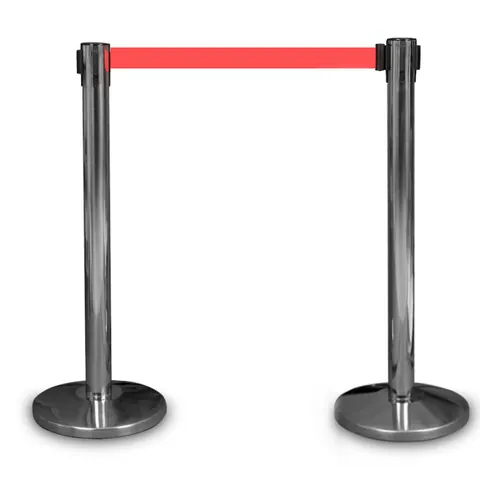
Barrier post Premium with retractable belt
from €54.22 incl. VAT6 versions
In stock — ships in 1–2 business days
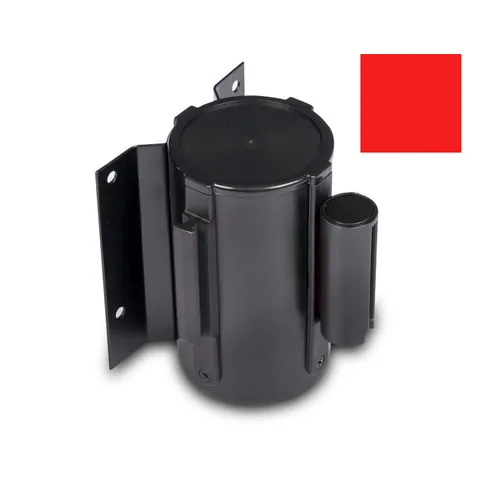
Wall-mounted retractable-belt head
from €35.69 incl. VAT2 versions
In stock — ships in 1–2 business days
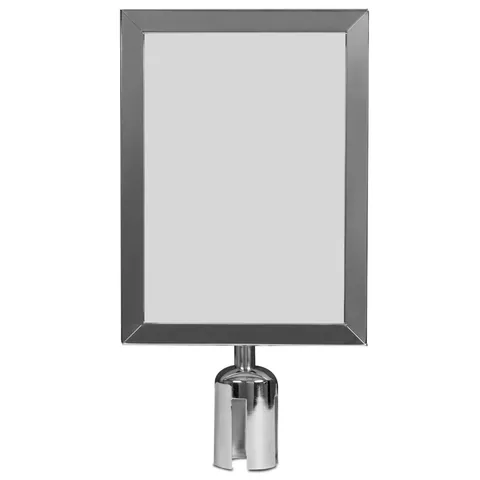
A4 barrier-post frame — chrome
€64.49 incl. VATIn stock — ships in 1–2 business days
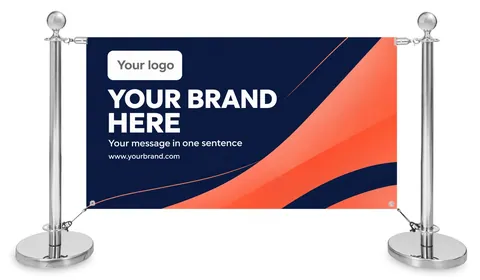
Cafeteria barrier set
from €138.27 incl. VAT2 versions
In stock — ships in 1–2 business days
How to set up a queue with barrier posts
Post spacing
The belt in the Premium post is 225 cm long, but in practice posts are placed closer together, usually every 1.5–2 m. A shorter span sags less and the taut belt does not pull hard on the post. With ropes, the spacing is set by the rope length: place the posts so the rope hangs in a gentle curve.
Lane width
For a single person, a lane about 90–120 cm wide is usually enough in practice. If people queue with pushchairs or luggage, or there are wheelchair users, plan wider lanes, especially at the turns. If the venue has accessibility guidance, check it before you set up the queue.
Straight, L-shaped or serpentine
A short queue can simply run straight along a wall, with a wall-mounted belt unit at the start. Where space is tight and queues can get long, build a serpentine layout: parallel lanes linked by turns. At the end of every inner line, leave a gap at least as wide as the lane so the turn does not become a bottleneck.
How many posts you need
Count each line separately: the length of the line divided by the spacing, plus one post at the end. Example: a queue with two 6 m lanes, formed by three lines at 2 m spacing, needs 4 posts per line, so about 12 posts in total. Where a wall can replace one of the lines, use wall-mounted belt units there instead.
Entry, exit and signage
Mark the start of the queue with an A4 frame on a post carrying a clear message, and keep the exit wide and free of obstacles. The queue should not end right at a door or block the counter where customers pay or collect documents. Our guide information boards covers formats and wording for notices.
Safety: escape routes and stability
Queue barriers must not narrow or block escape routes. Do not place them in front of emergency exits, fire doors, fire extinguishers or hydrants. Required route widths depend on the building, so in a public venue agree the queue layout with the person responsible for fire safety.
A belt can be unclipped in one movement, which helps open a passage quickly, but it is no substitute for a clear escape route. Stand the posts on a level, hard floor, away from stairs and ramps, and do not hang bags or signs on the belt or rope. The Premium post has a 6.5 kg base, so it stands steadily, but a strong pull can tip it over, especially with the belt fully extended. Before using any model outdoors, check on the product page whether it is designed for that.
Where queue barriers work well
- Public offices, banks, clinics — a queue to the counter with an A4 frame and numbered service points.
- Shops and service points — a single queue feeding several tills, or a separate click-and-collect area.
- Events and conferences — delegate registration, the entrance to the hall, the accreditation area. We cover the rest of the kit in conference equipment.
- Hotels, theatres, cinemas — rope with clasps at the entrance to a hall, at reception or a VIP area.
- Museums and galleries — keeping visitors at a safe distance from an exhibit.
- Cafés and restaurants — the Cafeteria set separating the guest area from the walkway.
Common queue layout mistakes
- Belt pulled out to full length — the span sags and posts tip over more easily when pulled.
- No sign at the start of the queue — customers join from the side or walk in from the exit.
- Turns that are too narrow — people stop at the corner and the whole queue stalls.
- A queue next to an emergency exit — even temporarily narrowing an escape route is not acceptable.
- Mixed finishes in one layout — chrome next to matt black and gold looks haphazard, especially at reception.
How to order queue barriers
You will find the full range in the queue barrier posts category, and stands for information and leaflets in the display and information stands category. Posts are packed in bulk: bases in fours and posts in twenties, with up to 60 posts on one Euro pallet. We ship stock items within 1–3 working days, with fast delivery across the EU and a VAT invoice.
Equipping several branches, an event venue or an agency's rental stock? Queue barriers fit naturally into office signage and service points. Send a quote request with the number of posts, belt colours and finish, and we will prepare a quotation with B2B prices.
Frequently asked questions
How far apart should retractable belt posts be?
The belt in the Premium post is 225 cm long, but in practice posts are placed every 1.5–2 m. A shorter span sags less and pulls less on the post, so the whole layout is steadier and looks neater. In a serpentine queue, also allow room for the turns: at the end of each inner line, leave a gap at least as wide as the lane itself.
Belt or rope: which is better for a queue?
A retractable belt is more practical wherever the queue layout changes often: public offices, shops, banks or event registration. Once unclipped, it retracts into the post, and you set the span by the post spacing. Rope with clasps has a fixed length and is chosen for formal settings such as hotels, theatres, galleries or the entrance to a VIP area.
Can queue barriers stand next to an emergency exit?
They should not narrow or block escape routes and emergency exits, fire doors, fire extinguishers or hydrants. Being able to unclip a belt quickly is no substitute for a clear route. Required escape route widths depend on the building, so in a public venue agree the queue layout with the person responsible for fire safety on site.
Can I change the belt colour in a barrier post?
That is what the replacement belt unit is for: a cassette with a 210 cm, 45 mm belt available in black, blue, green, white and yellow. You can use belt colour to separate a business customer queue from the standard one, or to mark a staff-only area. Before ordering, check on the product page that the unit fits your post model.
How do I end a queue at a wall?
The simplest way is a wall-mounted belt unit: a cassette with a 220 cm belt fixed to the wall. You pull the belt out to the nearest post, so there is no need for an extra post by the wall. Alternatively, fit a wall attachment and hook the end of a belt from a post onto it. Check on the product page that the attachment suits your belt or rope.