Trade show checklist: the plan in five steps
Good trade show preparation comes down to five jobs spread over at least 12 weeks. If it is your first show or you are replacing the whole stand, add a few weeks of slack. Graphic design, internal sign-off and booking meetings with customers usually take the longest.
- Goal and budget — how many conversations, meetings and enquiries you want to bring back, and how much you can spend.
- Stand and graphics — the build, the counter, literature and a design that fits your space.
- Team — who staffs the booth, how they open conversations and how they record leads.
- Logistics — transport, build-up, power, accommodation and access times for the venue.
- Follow-up — who replies to which contacts, and when, so conversations do not go cold.
Goal and budget: start 12 weeks before the show
Before you choose a stand, write down one measurable goal. It might be a number of conversations with companies in your target market, meetings booked for the weeks after the show, enquiries about a specific product or new distribution partners in a given country. The goal tells you how big the stand should be, how many people you need and which materials to prepare.
Break the budget into lines: space rental, stand build, graphics, transport, staff, literature and pre-show promotion. A full breakdown with ideas on where to save is in our guide to exhibition stand cost. If you exhibit several times a year, treat the stand as equipment for many events rather than a one-off purchase.
Read the organiser's exhibitor manual at this stage too. Check registration deadlines, the maximum build height, material requirements (for example flame-retardant fabrics), power connection rules and build-up and breakdown times. These rules differ from venue to venue, so do not assume they match your last show.
Exhibition planning timeline: 12, 8, 4 and 1 week before
The table shows what should be ready at each stage. The organiser's deadlines always come first, so put them in the calendar next to this plan.
| When | What to do | Outcome |
|---|---|---|
| 12 weeks before | Goal, budget, registration, choice of space, exhibitor manual | Confirmed space and a list of requirements |
| 8 weeks before | Stand layout, choice of system, design brief, literature list | Stand and furniture ordered |
| 4 weeks before | Artwork approval, printing, customer invitations, team training | Graphics ready and first meetings booked |
| 1 week before | Test build, packing, transport, staff rota, lead form | Stand packed and team briefed |
| 48 hours after | First messages to contacts, leads shared out in the team | Sales conversations under way |
12 weeks before the show
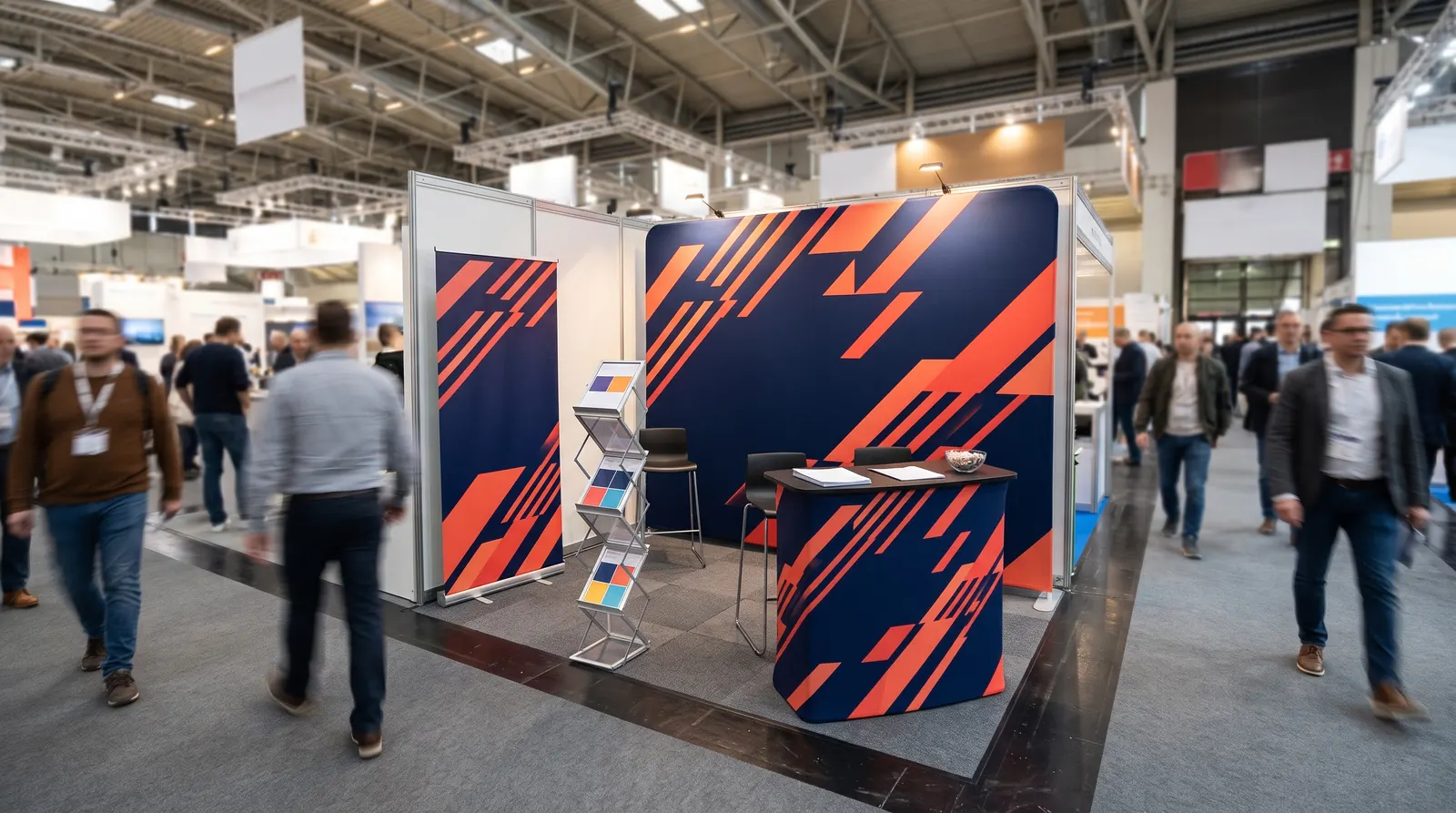
Book your space and choose the type: a row stand (one open side), a corner stand (two), a peninsula (three) or an island (four). The number of open sides tells you how many walls you need and from how many angles the booth has to look good. Note the exact dimensions, because they determine which system you can use.
8 weeks before the show
Draw a simple floor plan with measurements: back wall, counter, meeting area, literature and a clear walkway. Choose your display system and order it early enough to leave time for artwork. Write a brief for the designer: one headline message, the logo, a product photo and contact details.
4 weeks before the show
Approve the artwork and send it to print. Send invitations to customers and book meetings for specific times. Train the team: a short company pitch, three qualifying questions and one agreed way of recording leads.
1 week before the show
Build the whole stand in the office or warehouse, count every part and photograph the layout. Pack graphics in their covers, prepare a toolbox and print the staff rota. Confirm transport, parking and venue access times.
Exhibition stand and graphics: what to order and when
Most stands are built from three elements: a back wall with graphics, a counter for greeting visitors and literature people can take away. The right mix depends on your space and how often you exhibit.
- Pop up stand — opens like a concertina and packs into a case. The straight pop up display with case measures 274×230 cm when open and weighs 25 kg. The 3x3 label refers to the number of frame panels, not metres.
- Tension fabric display — the fabric graphic slips over the frame like a pillowcase. The Atlantis straight fabric wall comes in widths from 250 to 590 cm and weighs 7 to 15 kg depending on the size.
- Ready-made stand — a complete build for a specific footprint, such as the LUNIX 3x3 m peninsula stand. The LUNIX system has built-in LED lighting and assembles without tools.
- Exhibition counter — the Promo 2 counter measures 91×45×93 cm, weighs 10 kg and comes with a bag. The lighter Preston oval counter weighs 6 kg and its top takes up to 50 kg.
- Literature — the Montana leaflet stand with case holds A4 or A3 brochures depending on the version and protects them in transit.
Only design the artwork once you have chosen the exact model, because every system has its own print size with bleed. You can ask us about printing in a quote request or have the graphics printed by any print shop. We list the graphic size on every product page. File set-up (bleed, resolution, CMYK) is covered in our guide on preparing print files.
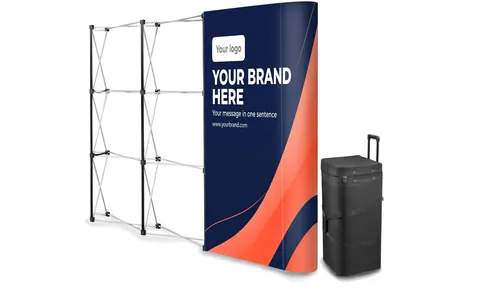
Straight POP UP display with case
from €284.31 incl. VAT2 versions
In stock — ships in 1–2 business days
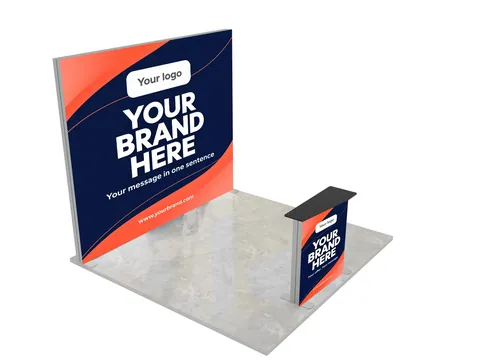
Exhibition stand using LUNIX 9 m² (3x3) peninsula layout
Request a quoteRequest a quote
- Deal of the week

Counter Promo 2 with heavy-duty top
from €117.63€153.94incl. VATLowest price in the 30 days before the discount: €153.942 versions
In stock — ships in 1–2 business days
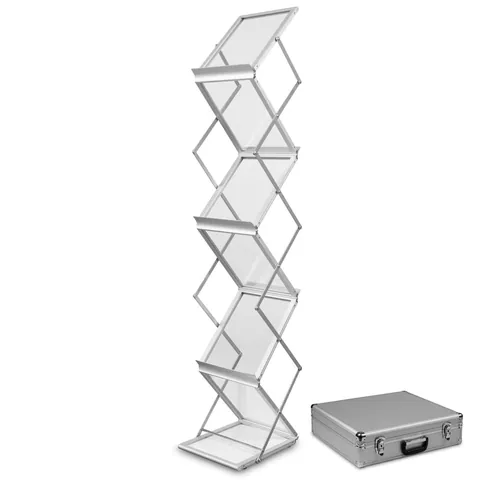
Leaflet stand Montana with case
from €140.24 incl. VAT4 versions
In stock — ships in 1–2 business days
Your booth team: roles, rota and conversations
A stand without a prepared team is just decoration. Agree roles: the stand manager looks after tidiness, the rota and meetings, product specialists handle the detail, and one person makes sure every lead is recorded. Keep at least two people on the stand at all times, so the booth is never left empty while someone is in a longer conversation.
Prepare a short conversation script. Instead of “Can I help you?”, open with a question about the visitor's business or what they are looking for at the show. Then ask three qualifying questions: what problem they want to solve, who makes the buying decision and when they need a solution. End every conversation by agreeing the next step.
Schedule breaks away from the stand. Eating behind the counter, sitting on a phone and chatting among colleagues put visitors off faster than weak graphics.
Logistics: transport, build-up and power
Measure and weigh every package before you book a vehicle. For example, a pop up display in its case takes up 45×45×93 cm, and the Promo 2 counter is packed in two boxes. Carry the heavier cases with two people.
- Protection in transit — the hard exhibition case S measures 134×43×27 cm with 102 litres of space. The Saver wheeled case rolls to the venue and can double as a counter on the stand.
- Power — you usually order a connection from the organiser. Bring an extension lead and a power strip if you have lighting or a screen.
- Labelling — mark every box with your company name, hall and stand number and the stand manager's phone number.
- Build-up — check access times and how long you have to build. A test build in the office shows how much time you really need.
Exhibitor checklist before you travel
Print this list and tick it off in the final week. The full kit list is in our guide to exhibition stand equipment.
Paperwork and organisation
- booking confirmation, hall plan and stand number,
- exhibitor passes, vehicle access and parking permits,
- staff rota and phone numbers for the whole team.
Stand and graphics
- every part of the build counted after the test build,
- graphics in their covers, checked for creases and damage,
- counter, literature stand, lighting and extension leads.
Literature and visitors
- catalogues, price lists, business cards and samples,
- a lead form (paper or on a phone) with space for notes,
- water, cups, cleaning supplies and bin bags.
Toolbox
- double-sided tape, scissors, cable ties, hook-and-loop strips,
- microfibre cloth, spare batteries and chargers.
After the show: follow up within 48 hours
The show ends when the hall closes, but the selling is only beginning. Enter leads into your system the same day, sort them into hot, warm and cold, and send the first message within 48 hours. Send hot leads a proposal within a week. The whole process is in our guide to trade show follow-up.
Check the kit when you get back as well: clean the graphics, count the parts and note what was missing. That note makes preparing for the next show much easier.
How to order your stand and equipment
In the shop you will find ready-made exhibition stands, display walls and exhibition counters. Products in stock ship within 1–3 working days across the EU, with a VAT invoice. Companies and agencies with a business account buy at B2B prices.
If you are preparing several stands, need a price for larger quantities or want to ask about graphic printing, send us a quote request.
Frequently asked questions
How far in advance should you prepare for a trade show?
Starting at least 12 weeks before the show is a safe rule. That gives you time to book space, choose the stand, design and print the graphics, invite customers and train the team. For a first show or a brand-new stand design, add a few extra weeks. Also check the organiser's own deadlines, because registration, utility orders and catalogue entries often close earlier.
What should an exhibitor bring to a trade show?
Bring the stand and its graphics, a counter, a literature stand, lighting and extension leads. Add catalogues, business cards, samples, a lead form and a toolbox with double-sided tape, scissors, cable ties and a cloth. Do not forget the paperwork: booking confirmation, exhibitor passes, vehicle access permits and the staff rota. Check the list after your test build.
How many people should staff a trade show booth?
Keep at least two people on the stand at all times, so one can hold a longer conversation while the other greets new visitors. For a larger stand or a full diary of meetings, plan more people and shifts. Agree roles in advance: a stand manager, product specialists and someone responsible for recording leads. Take breaks away from the stand.
When should you order the stand and the graphics?
Order the stand around 8 weeks before the show and the artwork as soon as you have chosen the exact model, because every system has its own print size. Products in stock ship within 1–3 working days, but design work and internal approvals usually take longer. Leave a week for a test build so you can spot anything missing.
Can you set up an exhibition stand yourself?
Yes, portable display systems are designed for self-assembly. A pop up stand opens like a concertina, a tension fabric display has a tube frame with a graphic that slips on like a cover, and the LUNIX system assembles without tools. Do a test build before the show and check the exhibitor manual for build-up times. Always follow the manufacturer's instructions.